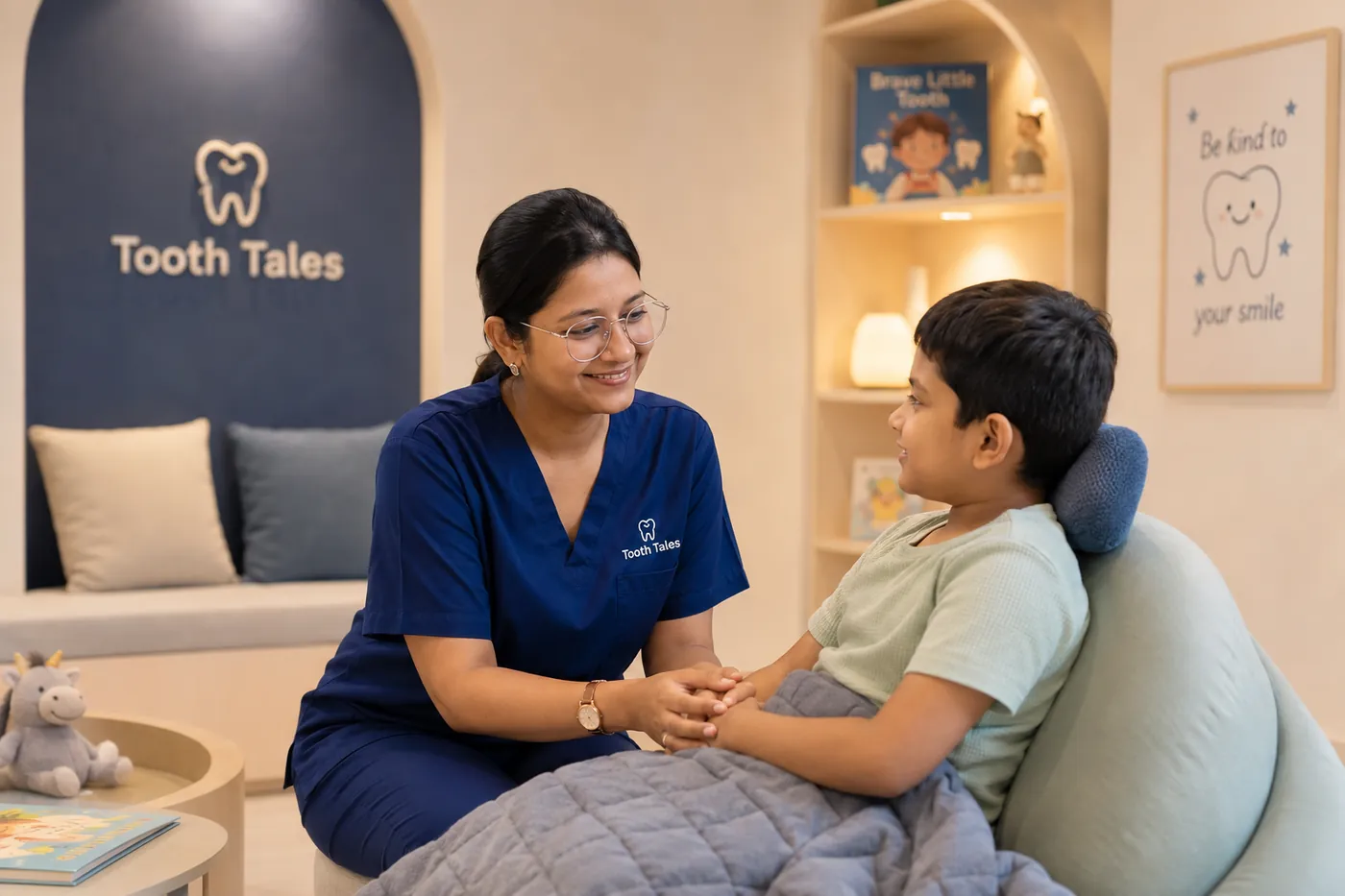
A dentist for children and adults who have been turned away
You have been told your child is difficult to treat. We take that appointment. Autism, ADHD, sensory processing disorder, intellectual disability and other neurodivergent conditions, at any age.
Ordinary dental care, set up differently
Special needs dentistry is for people whose condition makes a normal appointment hard, including autism, ADHD, sensory processing disorder and intellectual disability. The dentistry itself does not change. What changes is the room, the length of the visit and the words we use.[1]
Tooth Tales has treated children for fifteen years, and everything is built to one size: the room, the chair, the instruments, the appointment length. Special needs is the one exception to the age rule, and it runs to any age.
Where treatment happens depends on who it is for
Children are seen at the clinic
Phi II, Greater Noida. Jungle and aqua rooms, a play area, and at least 40 minutes for every appointment.
Tooth Tales, Phi IIAdults are treated in a hospital
Not at Phi II. An adult who needs support to get through treatment needs equipment a clinic floor is not built for. Which hospital depends on the case, and that is decided with you rather than announced to you.
Hospital settingThe first conversation still happens with us either way. You do not need a hospital referral to start. See all treatments at Tooth Tales.
Why you were turned away somewhere else
Across 17 studies in urban India, only 28.3% of dentists said they felt comfortable doing even simple procedures for patients with intellectual and developmental disabilities. More than half said their training was not good enough.[4]
That is a gap in a profession, not a verdict on your child.
When we treat, and when we would not
Holding a patient still has a name, protective stabilization, and it has published limits.[2] Here is where we stop.
✓ What we will do
- ✓ Take the appointment, and tell you honestly what it will take.
- ✓ Ask you first, in writing, before anything restrictive. Consent is recorded before, not explained after.
- ✓ Stop and rebook when today is not the day, and count that visit as a good one.
- ✓ Tell you when waiting will cost your child more than acting.
✗ What we will not do
- ✗ Hold a child still for our own convenience.
- ✗ Restrain a child who is already cooperating.
- ✗ Push on when there is no clear need to treat that day.
- ✗ Do full mouth work this way when it is not urgent.
- ✗ Proceed without asking you first.
But waiting is not free, and we will tell you so
Most clinics leave this part out. Putting care off can mean pain, more treatment later, a bigger bill, and a worse experience when it finally happens.
So we will not say “we will wait until your child is ready”, and we will not say “let us get it done today”. You get a plan with a next step in it, and the reasoning behind it. If that is the conversation you have been trying to have with a dentist, have it with us.
Is sedation safe for a child with special needs?
Second most asked question across the harvested queries. On this page it is really two questions: is sedation safe, and is a general anaesthetic safe.
Every step that involves sedation or anaesthetic starts with a full medical history, and sometimes a call to your child’s own doctor. The rule is the smallest intervention that will actually work, which is why a general anaesthetic sits at the bottom of the list rather than the top.
Does a general anaesthetic cause autism?
No. Research looked for that link, including for exposure before age two, and did not find it. Researchers still want more work done on brain development outcomes, and that is worth saying rather than hiding.[1]
A general anaesthetic is still not a small thing
It is a hospital procedure with fasting, monitoring and recovery attached. That is precisely why it is the last option on our list and not the first, and why we will tell you when we think it is genuinely the right one.
Who is doing the sedation
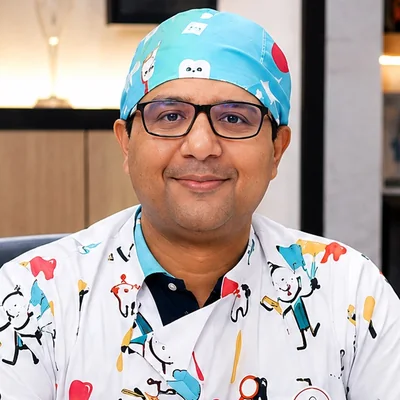
Dr. Sanchit Paul has been certified in conscious sedation since 2011 and holds the SAAPD Dr. J.C. Lee Nitrous Oxide Award, 2024. More than 5,000 laughing gas sessions have been run at Tooth Tales.[5]
Does it hurt? Usually the treatment is not the problem
For most children on this page, the thing that hurts is not the treatment. A parent bracing for the drill is often bracing for the wrong thing. These five are what actually cause the distress.
- 1
The light
Overhead, bright, straight in the eyes.
- 2
The sound
Suction, more than the drill.
- 3
Taste and texture
Gloves, and the gritty paste.
- 4
Temperature
A cold metal mirror on the lip.
- 5
Being touched
On the face, by someone new.
- 6
All five are changeable
Lower lighting, calmer sound, slower pacing.
This has a name, sensory-adapted dental environments, and it is recommended specifically for autism, sensory processing difficulties and dental anxiety.[2]
What happens at the first visit
Numbered because it really is a sequence, and because knowing the order is most of what calms a parent down. This is a child’s visit at the clinic. For an adult, the pathway is different.
- 1
The first 5 to 10 minutes
You arrive and nothing happens. Your child looks at the room.
5 to 10 min - 2
The chair is optional
Plenty of first visits happen in the play area, or on your lap.
- 3
Everything is shown first
Tell-show-do, the same approach used with any child.[2]
- 4
We practise the stop signal
Usually a raised hand. When your child uses it, everything stops.
- 5
A look inside, if today allows
If it is not possible, the visit still counts and still tells us plenty.
- 6
A plan and a named next step
You will know that step before you walk out.
What we would do instead of a general anaesthetic
Treatment under general anaesthetic is the last option, not the first. Everything before it is real.
Familiarisation
Gradual exposure across visits. Recommended specifically for autism, with no listed reasons not to use it.[2]
The clinicThe ordinary techniques
Tell-show-do, asking before telling, praise, distraction, the stop signal.
The chairLaughing gas
For a child who understands what is happening but cannot stay calm through it. How laughing gas works.
The chairGeneral anaesthetic
For treatment that must happen and cannot happen any other way.
Hospital theatreIn a study of autistic children in Italy, across 1,440 dental visits over three years, about half of treatments in the supported group were possible without a general anaesthetic.[3] Those were Italian children, and those are their numbers, not ours. If your child is in that last group, it is not a failure. Not yours, not theirs, not ours.
Questions parents ask us about special needs dentistry
These are the questions parents ask us most, in the words they ask them.
No. Research looked for that link, including for exposure before age two, and did not find it. Researchers still want more work done on brain development outcomes.
Not for our convenience, not when the treatment does not have to happen that day, and never without asking you first and recording it.
Grinding is common in autistic children, and it often happens in the day as well as at night. It is usually managed rather than stopped, and the first job is checking whether the teeth are being damaged.
Change one thing at a time. Try a toothpaste without SLS if foam is the problem, use a picture sequence instead of spoken instructions, and count brushing done by you as brushing done.
Yes, at any age. There is no upper age limit, and it is the one exception to a children-only practice. The difference is where: children are seen at the clinic, and adults are treated in a hospital setting rather than at Phi II.
Then that is where the first visit ends, and the next one starts from there. It is an ordinary place to begin.
References
Every clinical claim on this page is numbered and links to its source. Guideline bodies and peer-reviewed research only. All URLs checked 10 September 2026.
- 1
Management of dental patients with special health care needs. American Academy of Pediatric Dentistry. The Reference Manual of Pediatric Dentistry. Chicago, IL: AAPD; 2025:364–71. Latest revision 2021.
https://www.aapd.org/research/oral-health-policies–recommendations/management-of-dental-patients-with-special-health-care-needs/ - 2
Behavior guidance for the pediatric dental patient. American Academy of Pediatric Dentistry. The Reference Manual of Pediatric Dentistry. Chicago, IL: AAPD; 2025:379–99. Latest revision 2024.
https://www.aapd.org/globalassets/media/policies_guidelines/bp_behavguide.pdf - 3
Pastore I, Bedin E, Marzari G, Bassi F, Gallo C, Mucignat-Caretta C. Behavioral guidance for improving dental care in autistic spectrum disorders. Frontiers in Psychiatry. 2023;14:1272638. PMID 38034927. Autistic children in Italy, 1,440 dental visits across three years. Around half of treatments in the supported group avoided general anaesthesia.
https://www.ncbi.nlm.nih.gov/pmc/articles/PMC10682214/ - 4
Philip P, Gangaraju BA, Lim MAWT, Armstrong G, Grills N. Access to dental care among individuals with intellectual and developmental disabilities in India: a scoping review. Special Care in Dentistry. 2025;45(1):e13067. PMID 39375902. 17 studies, urban India.
https://pubmed.ncbi.nlm.nih.gov/39375902/ - 5
Tooth Tales clinic fact base and the CV of Dr. Sanchit Paul, 2025. Internal source, not publicly linkable.
Internal source, no public URL