

A dentist has said your child's milk tooth needs a cap, and you are wondering whether a tooth that will fall out really needs one, and whether it has to be silver.
A dental crown, or cap, covers a baby tooth that is too damaged for a filling. It is often needed when a cavity is large or the tooth has had nerve treatment. Crowns usually last longer and are less likely to fail than fillings in these cases. However, not every cavity needs a crown.
Steel (silver) caps stay on as well or slightly better. White zirconia caps look natural and keep the gums healthier, but need more of the tooth trimmed and usually cost more. Either way, the cap comes out with the milk tooth when the milk tooth falls out.
This page covers when a cap is needed and when it is not, silver against white, the cap that goes on with no drill, whether steel caps are safe, and how long caps last.
What is a crown on a milk tooth?
A crown is a ready-made cover shaped like a tooth. It fits over the whole tooth, so the tooth can be used for chewing again until it falls out naturally. Parents usually call it a cap; dentists call it a crown. They are the same thing.
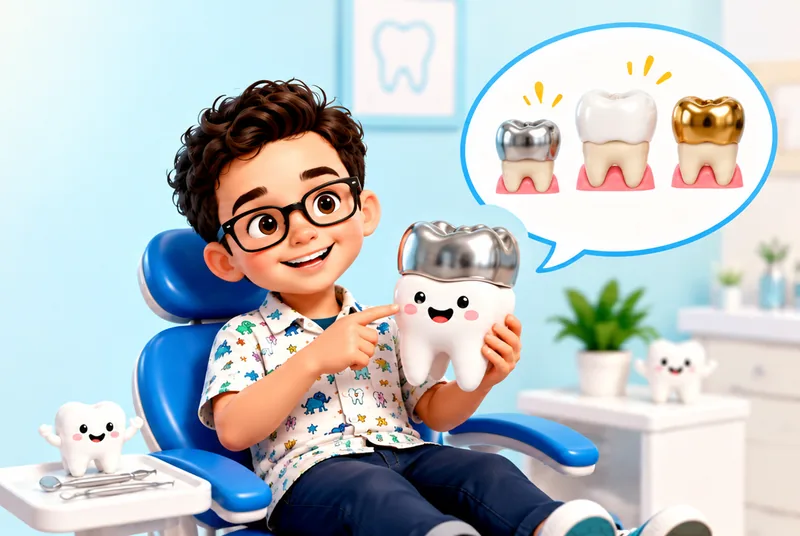
Caps for children come ready-made in different sizes. There are three main kinds: steel caps (silver), zirconia caps (white, made of a hard ceramic), and on front teeth, strip crowns (white filling material shaped inside a thin mould).
Steel cap (silver)
- Stays on as well or slightly better
- Less of the tooth trimmed
- Looks silver
Zirconia cap (white)
- Looks like a natural tooth
- Healthier gums around it
- More of the tooth trimmed
When does a child need a crown on a milk tooth?
The American Academy of Pediatric Dentistry (AAPD) lists these situations for a steel cap on a milk tooth:
- decay that is large, or spreads across several sides of the tooth;
- after treatment to the nerve inside the tooth (a pulpotomy or pulpectomy, the milk-tooth root canal);
- teeth that formed with weak or patchy enamel;
- when a filling would probably fail, for example decay between back teeth that has spread far, or heavy tooth grinding;
- a child at high risk of new decay, especially when treatment is done with sedation or general anaesthesia, so it does not need repeating.
For those teeth, the evidence favours a cap. A Cochrane review of milk back teeth found that, over the long term, caps were less likely to fail badly than fillings (346 teeth, three studies) and less likely to cause pain (312 teeth, two studies), both at moderate quality of evidence.
When a crown is not needed
Not every cavity needs a cap, and a dentist should be able to say why this one does.
- A small cavity on one side of the tooth. A filling is usually enough. The AAPD keeps caps for large or multi-sided decay.
- A chalky white patch with no hole. This is early decay, and it can be stopped with fluoride, without a drill.
- A tooth close to falling out. The AAPD says the time left before a milk tooth falls out should be weighed before it is restored.
- A child who cannot manage treatment yet. Silver diamine fluoride can stop the decay for now. How it works, and its black stain, are explained in silver diamine fluoride for kids.
Before you agree, these are fair questions to ask:
- How big is the decay, and how many sides of the tooth does it reach?
- Would a filling hold here? Why not?
- How long until this tooth falls out?
- Can the cap be white, and what does that change?
Why a milk tooth that will fall out is still worth treating is set out in do milk teeth even matter.
Silver or white caps for kids: which is better?
Both work. The difference is mainly in looks, gums, how much of the tooth is trimmed, and cost.
| Question | Steel (silver) | Zirconia (white) | Strip crown (white) |
|---|---|---|---|
| Used on | Back teeth, sometimes front | Back and front teeth | Front teeth |
| Looks | Silver | Like a natural tooth | Like a natural tooth |
| Staying on | As good or slightly better | Similar overall | Comes off more often |
| Gums around it | More bleeding in some studies | Healthier | More bleeding than zirconia |
| Tooth trimmed | Less | More | Needs enough tooth left to bond to |
| Cost | Lower | Higher | Not compared in these studies |
On back teeth
The AAPD says that where a steel cap would be used, a zirconia cap may be used instead for appearance, and that steel caps stay on comparatively better while zirconia caps keep the gums healthier. A 2026 review of seven trials and 700 caps found no real difference in how well the two stayed on. The zirconia caps had healthier gums and less plaque, and parents strongly preferred them. The review also noted that zirconia, being harder, may wear the opposite tooth more, and that it costs more.
Zirconia caps cannot be bent to fit, so more of the tooth has to be trimmed for them, according to the AAPD.
On front teeth
A 2026 review of seven trials in milk front teeth found zirconia caps stayed on in at least 95% of cases at 12 to 18 months, against 46% to 79% for strip crowns, with healthier gums and a closer colour match. Strip crowns can still be a good choice: the AAPD notes high parent satisfaction, and that they need enough tooth left to bond to.
If appearance does not matter for a back tooth, parents often accept silver. A 2026 review of 126 studies found that, across the studies, a median of 81.9% of parents accepted steel caps on back milk teeth.
Can a cap go on with no drill and no injection?
Sometimes. In the Hall technique, a steel cap is pressed over a decayed milk back tooth with no injection, no drilling out of the decay and no trimming. Sealed under the cap, the germs lose their food supply and the decay stops.
- In a Scottish trial of 132 children aged 3 to 10, after five years, 3% of Hall caps had a major failure, against 16.5% of the usual fillings.
- A 2024 review of 15 trials found a 98% success rate at 12 months.
- A 2023 review comparing the Hall technique with the usual way of fitting caps found success above 85% for both at 12 and 24 months, with a shorter appointment for the Hall technique.
It can still be uncomfortable. Before the cap, a small rubber spacer may be placed between the teeth for a few days, and biting the cap into place can be uncomfortable, according to the AAPD. A Cochrane review found less discomfort with Hall caps than with fillings. The AAPD suggests the Hall technique where a child cannot manage the usual treatment.
Are silver caps safe for kids?
Steel caps contain nickel. A 2020 review of 17 studies found that evidence of allergic reactions to them in children is limited and mostly low quality. Some studies found the nickel released was less than what children take in from a normal diet; others found more is released when the mouth is acidic.
If your child has a known nickel allergy, tell the dentist. A white zirconia cap is an option.
Does getting a crown hurt?
For a cap fitted the usual way, the tooth is numbed with a local anaesthetic first, so the trimming should not hurt. With the Hall technique there is no injection, but there can be pressure from the spacer and when the cap is pressed on. Some children manage either one awake; others need laughing gas or general anaesthesia.
How long do crowns last on milk teeth?
A cap is meant to stay until the milk tooth falls out, and then it comes out with the tooth.
Caps can still fail. The AAPD lists a cap coming off and a cap wearing through as the main reasons steel caps fail. In five older studies, steel caps had an average five-year failure rate of 7%, against 26% for multi-sided silver fillings. One university clinic's zirconia caps were still in place in 93% of cases at one year, 85% at two years and 76% at three years.
If a cap feels loose or comes off, keep it and call the clinic.
How much does a crown for a child cost?
There is no single price, because the fee depends on the type of cap, how many teeth need one, and whether the treatment needs laughing gas or general anaesthesia. White zirconia caps generally cost more than steel ones.
- Is the fee per tooth?
- What is the difference in cost between a steel and a white cap for this tooth?
- Does the fee include the nerve treatment, if the tooth needs it?
How caps fit with fillings, nerve treatment and SDF is on the treatment page.
When is it worth booking a visit?
- A dentist has recommended caps and you want a second opinion. Take the questions above with you.
- A tooth hurts on its own, or the gum beside it is swollen. Book soon.
- A cap feels loose or has come off.
- You can see a dark spot or a hole in a milk back tooth.